February 2026 Newsletter

Insights, training opportunities, and updates to help communities thrive across Georgia and beyond.

Don't Miss Your Chance: Advance Your Career in Economic Development

Atlanta Georgia at sunset

Basic Economic Development Course (BEDC)

We’re less than one month away from the 2026 BEDC! This is your chance to sign up for the nation’s original course, designed to teach you the fundamentals you need to be successful in economic development. This course is accredited by the IEDC and counts toward CEcD credits.

Board Boost: Development Authority Training

Also in March, we’re offering the next session in our popular Board Boost webinar series. Over 150 Development Authority members in Georgia are already certified compliant with GA Code § 36-62A-21(b), don’t miss out!

A row of houses sitting on a bookshelf
A man points toward an icon of interconnected gears

Tailored Trainings

We’re happy to offer trainings customized to your team. If you’re interested in learning about AI for the Public Sector or AI in Workforce Development, please reach out to our Assistant Director, Leigh Hopkins.

Come See the CEDR Team

Come see our Director, Dr. Alfie Meek, present at the March 12th Partnership Gwinnett Economic Outlook luncheon.

From Partnership Gwinnett: “Want to stay ahead of the economic trends shaping the year? The Economic Outlook is your go-to event for expert insights on the year ahead.

Join nationally recognized economist and Georgia Tech Enterprise Innovation Institute Director of the Center for Economic Development ResearchAlfie Meek, Ph.D., as he delivers an engaging and data-driven presentation on key economic trends and future projections. Gain valuable insights on inflation, interest rates, recession risks, labor market trends, wage growth, federal debt, and more.

Whether you’re a business leader, investor, or policymaker, this event will equip you with the knowledge to navigate the evolving economic landscape.”

News from Georgia Tech

Subscribe Here

The Risk of the Status Quo: Why Continuous Georgia Board Training Is Your Best Defense

Local Development Authorities sit at the center of a community’s economic future. They approve incentives, structure deals, and make decisions that shape a region’s competitiveness for decades. In many ways, the board is the backbone of local growth—but even the most dedicated board can be sidelined by a technicality they didn’t see coming.

Most board members step into their roles as community champions, not legal experts. And without specialized Georgia board training—now reinforced by state law—well-intentioned boards can slip into procedural missteps or outdated practices that put their community at risk.

Under GA Code § 36-62A-21(b) (as amended by SB?171), Development Authority members must complete two hours of continuing training each year; failure to do so for two consecutive years results in suspended voting rights. (Note: Downtown Development Authorities are exempted by O.C.G.A. § 36-62A-22.)

That’s why CEDR created Board Boost—a free, live, two-hour training delivered virtually and aligned to the state’s continuing education requirement. Each session includes timely legal updates alongside an applied topic, so boards stay current, compliant, and confident.


Avoiding the Legal Headache

Compliance isn’t a “learn as you go” skill. Development Authorities operate within a complex framework, where small deviations can have outsized consequences.

Consider a recent example from 2025: the Cairo Downtown Development Authority successfully challenged the city’s removal of its board members. According to the ruling, the city violated Georgia’s Open Meetings Act by improperly using an executive session to vote on the removals. The court voided the city’s decision and reinstated the DDA members. It’s a clear reminder that process matters—and that missteps can trigger litigation, delay, and reputational damage. [Thomasville Times-Enterprise]

SB 171 raises the stakes on board readiness. In addition to the initial training expectations, recurring two-hour annual training now applies to Development Authority directors beginning after July?1, ?2025, with a penalty of suspended voting rights after two consecutive years of noncompliance. (DDAs are exempt from this recurring requirement.)

Common pitfalls that training helps prevent include:

  • Improperly noticed meetings or executive sessions
  • Gaps or inconsistencies in incentive documentation
  • Procedural errors during bond approvals
  • Operating under policies that haven’t been updated in years

An educated board is a protected board. Board Boost dedicates one hour of every session to Recent Developments in Economic Development Law, ensuring members stay aligned with current statutes and case law rather than “how we did things ten years ago.”


Closing the Opportunity Gap

Site selectors and project teams evaluate more than just your acreage—they assess your board’s professionalism and pace. When a board hesitates because a deal structure is unfamiliar, the project doesn’t wait; it moves to the next county.

Board Boost equips members to evaluate modern financing tools and negotiation trends with clarity. Recent sessions have featured applied topics like:

  • Workforce Housing as an economic development strategy.

  • The Local Impact of Data Centers (fiscal impacts and infrastructure).

  • C-PACE (Commercial Property Assessed Clean Energy): Understanding how these new resiliency improvements introduce unique lien-priority and intercreditor considerations.

Training helps members spot both the opportunity and the complexity before a vote is ever cast.


A Small Investment with a Large Return

Board training isn’t a one-time orientation; it’s a core element of your community’s risk management strategy. For Development Authorities, it’s an annual requirement with real consequences for noncompliance.

A well-trained board avoids compliance mistakes that create legal and reputational harm, builds instant credibility with developers and partners, and makes faster, clearer decisions aligned with best practices.


Stay Ready: Join an Upcoming Board Boost Session

If your community wants to reduce risk, strengthen decision?making, and maintain full compliance with Georgia’s continuing education requirement, Board Boost is the place to start.

Check the upcoming Board Boost schedule or contact us for more information. Your board—and your community—deserve to operate from a place of clarity, confidence, and strength.

CEDR Newsletter – November 2025

CEDR Newsletter — November 2025

Insights, training opportunities, and updates to help communities thrive across Georgia and beyond.

CEDR in the News

A CEDR study presented to the Columbus City Council found that the city faces a growing shortage of affordable and available housing — especially for middle-income residents — as the region expands its economic development efforts.

Pembroke Receives First CECR-C Designation

When the Hyundai Metaplant and its suppliers began reshaping the Coastal Georgia economy, the City of Pembroke found itself at an inflection point: ride the wave—or be swamped by it. This is the story of how community leaders partnered with CEDR to create a clear, community-backed plan for economic development readiness.

Board Boost Trainings

CEDR’s Board Boost series continues to support Development Authority board members with timely, relevant training:

  • Jan 20, 2026
  • Mar 17, 2026
  • Jun 16, 2026

All sessions are free, virtual, and count toward GA Code § 36-62A-21(b).

AI for the Public Sector

  • Dates: Feb 3–4, 2026
  • Location: AMPF, Atlanta
  • Cost: $425
  • Speakers include:
    • Brent O’Guin (AI Strategist)
    • Dr. Steve Ledbetter (Spalding County Manager)
    • Catherine Cooper (World Connections)
    • Dr. Michael Barker (Cybersecurity Faculty)

Learn how AI can improve public service delivery, data transparency, and decision-making.

The Basic Economic Development Course (BEDC) at Georgia Tech

  • Dates: Mar 23-25, 2026
  • Location:  GLC, Georgia Tech
  • Cost: $850 (discounts available for IEDC members and current students)
  • Speakers include:
    • Matt Forshee (Regional Economic Development Manager)
    • Margaret Stagmeier (Managing Member at Mission Partners)
    • Crystal Morphis (Founder and CEO at Creative Economic Development Consulting)

Advance your expertise in economic development planning with Georgia Tech’s nationally recognized 3-day Basic Economic Development course, accredited by the International Economic Development Council.

Get CEDR in Your Inbox

The CEDR newsletter shares research, housing trends, and workforce insights—monthly, no spam.

How Pembroke Demonstrates Economic Development Readiness

From Pressure to Playbook: How Pembroke Became Georgia’s First CEDR-C™ Community

Smarter growth, not sprawl. When the Hyundai Metaplant and its suppliers began reshaping the Coastal Georgia economy, the City of Pembroke found itself at an inflection point: ride the wave—or be swamped by it. This is the story of how community leaders partnered with CEDR to create a clear, community-backed plan for economic development readiness—culminating in Georgia’s first Certified Economic Development Ready Community (CEDR-C™) designation.

Key Findings…

  • Residents expressed support for gentle increases in density and a broader variety of housing options.
  • Average home prices in Pembroke have risen by 75% since 2020, reaching approximately $271,640.
  • To afford the average home, a household income of around $81,000 is required.
  • Residents aged 35 to 44 are disproportionately represented in the rental market, making up 9% of the population but 21% of renters.
  • Based on average salaries for top occupations in North Bryan County, most homes require dual incomes to be affordable.
  • Households in the primary workforce age range are less likely to own homes in Pembroke compared to Bryan County overall.
  • Catalyst sites present opportunities for quick wins that can help transform neighborhoods and support broader development goals.

…And Recommendations

  • Adopt friendly development policies like expedited permitting, incentives for affordability, pre-approved plans, and clear processes.
  • Utilize an infill overlay designation to encourage more diverse housing types in the historic downtown core.
  • Capitalize on public land for “proof of concept” missing middle housing; let these sites serve as catalysts for adjacent, market-driven, development.
  • Maintain open communication with regional partners to support consistency across goals, leverage the strengths of other communities, and fill in market gaps.

The Struggle: Growth shock meets identity

Pembroke sits about 10 miles from the Hyundai Metaplant America (HMGMA). Regional modeling points to 6,000+ new residents and 2,300+ households arriving in Bryan County over the next 8 years—pressure that shows up first in housing and infrastructure. Within the city:

  • Home prices climbed ~75% since 2020 (avg. – $271,640).
  • 36% of renters are cost-burdened (spending 30%+ of income on housing).
  • Market-rate rentals are scarce—just 46 units citywide.
  • Most households have one earner (~$32k median earnings), while two-earner households (~$90k) can better compete for housing—widening the attainability gap.

Community voices were clear: residents wanted walkable, human-scale places, more options than one large lot / one big house, and a plan that keeps Pembroke “Pembroke.” That’s where economic development readiness becomes more than a buzzword—it’s a success strategy.

The Turning Point: Listening first, then modeling

Instead of starting with a map of where to build, Pembroke and CEDR began with who and why:

  • Stakeholder interviews surfaced affordability and availability as top concerns, plus infrastructure limits (water, wastewater, traffic) and the risk of losing small-town character.
  • A community listening session let residents react to real street-scale visuals. People gravitated toward patterns like “Porch & Plaza” and “Nature’s Nest”—walkable blocks, front porches, and tree-linked spaces that fit the historic core.
  • We ran Phase 1 of the CEDR-C™ process using the Future Impact Simulation to localize housing and infrastructure needs.

Takeaway: Before you discuss density, align on design and place. A visual, map-based conversation unlocked constructive agreement on where small-format homes make sense (near corridors and the historic grid) and where quieter single-family patterns endure. This step is foundational to economic development readiness because it builds consensus before change accelerates.

The Diagnosis: What the numbers actually said

The analysis clarified the stakes—and the opportunity:

  • Attainability math: Typical workforce earners ($53k–$80k) support monthly housing costs of roughly $1,300–$2,000, implying they can afford home prices – $168k–$268k (under standard assumptions). That’s well below many current listing prices—hence the housing squeeze.
  • Demographics: Ages 35–44 are overrepresented among renters (9% of population, 21% of renters), signaling pent-up demand for starter homes and family-friendly rentals.
  • Pipeline reality: 3,400+ units are approved (mostly in large PUDs). That adds supply, but without policy signals, it may miss workforce price points.
    (Source: Final Pembroke CEDRC Report 2025)

This is where Workforce Analysis and Housing Needs Analysis matter: they translate paychecks, households, and tenure into target price/rent bands, then align product types and locations accordingly. Pair that with Fiscal Impact Analysis to understand municipal costs and revenues by scenario—and you can prioritize what creates long-term community value. These tools are the backbone of economic development readiness.

Co-Creating the Solution: Codes, sites, and capacity—sequenced

Pembroke and CEDR turned findings into a practical playbook that pairs policy, place, and pipes:

Policy already in motion

  • Cottage Housing ordinance
  • Accessory Dwelling Units (ADUs) allowed
  • Updated zoning and subdivision standard

What we added to the roadmap

  • Infill Overlay District around the historic core to unlock human-scale, small-lot patterns with right-sized parking and sidewalks.
  • Pre-approved plan sets (small single-family, cottage court, duplex, quad, and ADUs) to cut soft costs and time.
  • Expedited approvals for projects delivering units in the workforce bands.
  • A vacant/blight tax option to nudge underused properties back into productive use.

Proof-of-concept sites (to show the market what “good” looks like)

  • There are several potential public parcels in Pembroke that can serve as low-risk, proof of concept sites for gentle density increases.

Infrastructure sequencing (so growth is fiscally and operationally sane)

  • Water: Two municipal wells and a partnership well provide a ~580,000 GPD headroom today (avg. use – 260,000 GPD vs. 840,000 GPD permitted).
  • Wastewater: Expansion from 0.5 MGD – 1.0 MGD by end of 2027, with lift station and sewer-line upgrades in progress.
  • Mobility: Coordinate new housing with US-280 widening and potential CAT commuter express routes identified regionally.

The principle: Place the right units in the right placesnear existing or planned capacity—and you reduce per-unit costs, shorten approvals, and make more homes pencil out at workforce price points.

The Outcome: Ready—and recognized

With the two-phase process complete, Pembroke earned the inaugural CEDR-C™ designation—a third-party signal that the city has a credible, community-endorsed plan across housing, infrastructure, land use, and engagement. The designation supports developer confidence, strengthens grant narratives, and most importantly, gives local leaders a shared blueprint to build from.

The Pembroke team receives their CEDR-C certificate.

What Your Community Can Copy (Start Here)

  • Listen visually. Host a map- and image-based session to calibrate where small-format housing belongs and what it should look like.
  • Stand up an Infill Overlay. Around your historic or walkable core, tune setbacks, lot sizes, parking, and sidewalk requirements to match human-scale patterns.
  • Lower friction. Publish pre-approved plan sets and expedite projects that deliver workforce price points.
  • Sequence with capacity. Document water/wastewater headroom and align phasing with planned corridor improvements.
  • Prove it with pilots. Deliver two prototypes (e.g., a cottage court and a duplex/quad on a corner lot) on public or partner land to set expectations and de-risk the market.

Where CEDR Fits (and how we helped)

  • Housing Needs Analysis – Target price/rent bands by household type; location logic for infill vs. greenfield.
  • Workforce Analysis – Wage reality by occupation; product/tenure mix that works for local earners.
  • Strategic Planning – Infill Overlay standards, plan sets, entitlement pathways, public-site strategy.
  • Fiscal Impact Analysis – Phase housing with infrastructure, stress-test municipal budgets, and prioritize catalytic moves.

Want a readiness roadmap?

Your community can do this, too. If you’re facing industrial-driven growth, price pressure, or housing scarcity—and want to preserve the local character that people love—let’s build a readiness playbook you can actually use.

ACKNOWLEDGMENTS

The CEDR team extends its sincere appreciation for the community support that made this project possible. The contributions of city staff, in time, space, and ideas, greatly strengthened the quality and depth of this report. Additional thanks are due to the community stakeholders who participated in the qualitative components, and to the Coastal Regional Commission for facilitating the connection between CEDR and the City of Pembroke.

City of Pembroke
Tiffany Zeigler | Mayor
Chris Benson | City Administrator
Derek Cathcart | Community Development Director
Fernanda Camacho Hauser | GICH/DDA/Director of Downtown & Economic Development

Community Stakeholders
Dave Williams
Corde Wilson
Charlotte Bacon
Anne Barton
Shalah Beckworth

Coastal Regional Commission

CEDR Newsletter – September 2025

CEDR Newsletter – September 2025: Explore insights on housing demand in Columbus, new workforce initiatives through ARC INSPIRE, and upcoming Board Boost training for Georgia Development Authorities. Plus, celebrate our first CEDR-C™ community and stay ahead with strategic updates for economic growth.

CEDR Newsletter — September 2025

Insights, training opportunities, and updates to help communities thrive across Georgia and beyond.

Board Boost: Development Authority 2-Hour Supplemental

Stay Ahead of New Requirements: These free, live webinars provide Georgia Development Authority Board Member Training aligned to SB 171’s 2-hour annual continuing education requirement. Choose one of four dates at 9:00–11:00 a.m. ET, complete the two hours in one morning, and receive a certificate after attendance verification.

CEDR in Action – ARC Award

Building Pathways to Prosperity in Northwest Georgia: CEDR and GaMEP have been awarded an ARC INSPIRE grant to launch Project Purpose: Pathways to Prosperity. This initiative will expand workforce training and recovery-focused services for justice-involved individuals in Polk, Floyd, and Chattooga counties.

Celebrating Our First CEDR-C™ Recipient!

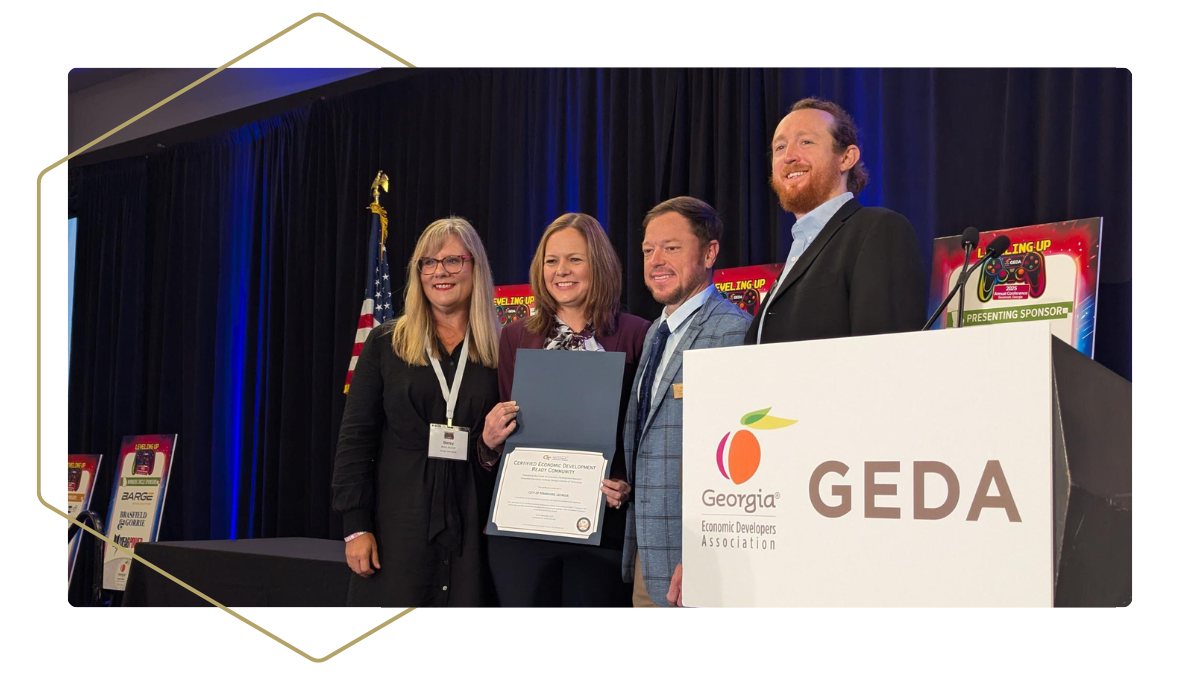
We’re proud to announce that the first Certified Economic Development Ready Community (CEDR-C™) award was presented to Pembroke, GA at the Georgia Economic Developers Association (GEDA) conference! This program recognizes communities that demonstrate strategic readiness for economic growth through planning, workforce development, and infrastructure.

CEDR Insights: Housing Demand in Columbus

The Chattahoochee Valley is projected to add 36,000 new residents by 2035, creating demand for 14,000+ new housing units. Our latest study explores the affordability and availability of workforce housing throughout the region.

Get CEDR in Your Inbox

The CEDR newsletter shares research, housing trends, and workforce insights—monthly, no spam.

CEDR and GaMEP Awarded ARC Grant to Expand Workforce Opportunities in Northwest Georgia

Big News for Workforce Development in Northwest Georgia

The Appalachian Regional Commission (ARC) has awarded a $56,731 grant to the Georgia Tech Research Corporation for Project Purpose: Pathways to Prosperity in Northwest Georgia. This planning initiative will strengthen workforce training and recovery-focused services for justice-involved individuals with substance use disorder (SUD) in Polk, Floyd, and Chattooga counties.

See the full list of ARC INSPIRE awards in the September 2025 announcement PDF.


About the Project

This 18-month planning effort will unfold in three phases:

  • Assessment and Partnership Development – Building strong local collaborations.
  • Curriculum and Employer Engagement – Designing recovery-to-work training programs and connecting with employers.
  • Implementation Planning – Creating long-term strategies for sustainable impact.

The ultimate goal? A recovery-to-work curriculum expansion plan and an employer engagement strategy that will guide implementation and deliver lasting benefits to the region.


CEDR’s Role in Driving Change

The Center for Economic Development Research (CEDR) at Georgia Tech is proud to co-lead this initiative alongside the Georgia Manufacturing Extension Partnership (GaMEP). Together, we’re leveraging data-driven insights and industry expertise to create pathways to prosperity for individuals and communities across Northwest Georgia.

“It will take all of us working together to help those in recovery get back on their feet. This effort builds fresh pathways to work, wages, and wealth—good news for public health and economic growth,” said ARC Co-Chair Maryland Gov. Wes Moore in the official announcement.


Why This Matters

Workforce shortages and barriers to employment remain critical challenges in rural communities. By addressing these issues head-on, Project Purpose will not only support individuals in recovery but also help local employers access a broader, more resilient talent pool.


What’s Next

The planning process is already underway, and we’ll share updates as the project progresses. Stay tuned for insights, milestones, and opportunities to get involved.

Want to follow along?

Why AI Literacy Matters in Government

Why AI Literacy Matters in Government

Artificial Intelligence (AI) isn’t just a buzzword—it’s a tool that’s quietly transforming how governments serve their communities. From traffic optimization to housing analysis, AI is already at work behind the scenes. But here’s the catch: if public officials don’t understand how AI works, they can’t lead its responsible use.

That’s where AI literacy comes in.


What Is AI Literacy, Really?

AI literacy isn’t about becoming a coder or data scientist. It’s about understanding the basics—what AI can do, where it’s being used, and what risks and opportunities it brings. It’s knowing enough to ask the right questions, make informed decisions, and ensure that technology supports public service goals.

For government leaders, AI literacy means being able to:

  • Evaluate vendors and tools with a critical eye.
  • Shape policies that reflect real-world needs.
  • Communicate clearly with constituents about how AI is being used.

Why It Matters for Public Officials

Government leaders are stewards of public trust. When AI is used in decision-making—whether it’s allocating resources or predicting infrastructure needs—citizens deserve clarity and accountability.

Here’s why AI literacy is essential:

  • Informed Policy Making: Leaders who understand AI can craft smarter regulations and avoid unintended consequences.
  • Responsible Use: AI can reinforce bias or errors if not carefully managed. Literacy helps leaders spot red flags.
  • Workforce Readiness: As AI tools become more common, teams need guidance and support to adapt.
  • Innovation with Guardrails: AI has the potential to improve efficiency and support creative problem-solving—but only when its limitations and risks are clearly understood and managed.

Real-World Examples of AI in Local Government

Across the country, local governments are using AI to:

  • Predict traffic patterns and reduce congestion:
    In Pittsburgh, PA, adaptive traffic signals powered by AI are helping reduce wait times and emissions. Developed with Carnegie Mellon, these smart systems respond to real-time traffic conditions.
  • Analyze housing trends to guide development:
    Los Angeles County is using AI to identify individuals at risk of homelessness by analyzing data across agencies. This helps case managers intervene early and guide housing policy.
  • Monitor infrastructure for maintenance needs:
    Houston, TX equips garbage trucks with cameras and sensors to detect illegal dumping and infrastructure damage. AI analyzes the footage to prioritize repairs and optimize routes.
  • Improve emergency response times:
    California’s Department of Forestry and Fire Protection uses AI-powered image recognition to support early wildfire detection, with human responders verifying and acting on alerts.

The Risks of Staying in the Dark

When AI literacy is low, governments face real challenges:

  • Misuse of Tools: Relying on AI without understanding its limitations can lead to poor outcomes.
  • Procurement Pitfalls: Choosing the wrong vendor or solution can waste time and money.
  • Public Distrust: Citizens want to know how decisions are made. If AI is involved, leaders need to explain it clearly.
  • Missed Innovation: AI can assist in addressing complex challenges—but it should complement, not replace, human judgment and expertise.

How to Build AI Literacy in the Public Sector

The good news? You don’t have to go it alone.

Programs like AI 101 for Local Officials are designed to help public officials understand the fundamentals of AI, ask informed questions, and evaluate its relevance to their work. These sessions offer practical insights, real-world examples, and space for discussion. They’re built to inform, not overwhelm.

Other ways to build AI literacy:

  • Partner with universities and civic tech groups.
  • Encourage cross-departmental learning.
  • Create space for experimentation and feedback.

Image of a suburban neighborhood with digital graphic overlay

Upcoming Opportunity: AI for the Public Sector at Georgia Tech

If you’re ready to take the next step, Georgia Tech is offering a two-day course, AI for the Public Sector, on October 14–15, 2025 at the Global Learning Center in Atlanta.

This course is designed for city and county officials, chambers of commerce, downtown development authorities, educators, and other public sector professionals. You’ll learn:

  • Core AI concepts and terminology
  • Applications of AI across sectors
  • How to evaluate and implement AI solutions effectively

Dates: October 14–15, 2025
Location: Global Learning Center, Atlanta, GA
Cost: $795
Registration Deadline: October 7, 2025
Learn more and register here


Let’s Learn Together

AI is becoming more common in public sector work. With careful oversight and informed leadership, it can be a useful tool.

If you’re curious about how AI can support your work, we invite you to join us for AI 101 for Local Officials on August 7 and 14, or the AI for the Public Sector course in October.

Register for AI 101
Register for AI for the Public Sector

Let’s ensure that public leaders are equipped to make informed decisions about emerging technologies.

Content on this page was generated (wholly, or in part) using a Large Language Model tool. All AI-generated content is reviewed, edited, and revised to publication, and follows the?Institute’s Editorial Style Guide. 

Join Us for the Georgia AIM Cyber Workshop Event!

The Cyber Workshop event from Georgia AIM is just around the corner, and it’s an exciting opportunity for professionals and enthusiasts in the field of cybersecurity to come together, learn, and network. This event promises to be a valuable experience for anyone looking to stay ahead in the ever-evolving world of cybersecurity.

Event Details

  • Date: Tuesday, April 22
  • Time: 9am – 3pm
  • Location: Middle Georgia Regional Commission

Agenda Highlights

The workshop will feature a series of informative sessions and hands-on activities designed to enhance your cybersecurity skills. Some of the key highlights include:
  • Cybersecurity and AI: Explore how Artificial Intelligence (AI) is revolutionizing the manufacturing industry and the cybersecurity challenges that come with increased connectivity. Learn practical strategies to protect your operations while harnessing the power of AI.
  • CIS Controls: Understand the Center for Internet Security (CIS) Controls, a set of best practices for securing IT systems and data against cyber threats. These controls are essential for any organization looking to improve its cybersecurity posture.
  • DoCRA: Dive into the Duty of Care Risk Analysis (DoCRA) framework, which helps organizations assess and manage risks in a way that balances security with business needs. This session will provide valuable insights into making informed decisions about cybersecurity investments.
  • Becoming a Trusted Supplier of Choice: Discover how to build trust with your customers and partners by implementing robust cybersecurity measures. This topic is crucial for businesses looking to differentiate themselves in a competitive market.
  • Cyber Insurance: Learn about the role of cyber insurance in mitigating the financial impact of cyber incidents. This session will cover the benefits and considerations of cyber insurance policies, helping you make informed decisions about coverage.
  • Cyber and AI in the Future: Gain insights into the future of cybersecurity and AI, including emerging trends and technologies. This forward-looking session will help you stay ahead of the curve and prepare for the challenges and opportunities that lie ahead.

About Georgia AIM

Georgia AIM (Advanced Industrial Manufacturing) is an initiative focused on advancing the manufacturing industry in Georgia through innovation, education, and collaboration. The goals of Georgia AIM include:
  • Promoting Innovation: Encouraging the adoption of advanced technologies and practices to enhance productivity and competitiveness.
  • Education and Training: Providing resources and training opportunities to help professionals stay up-to-date with the latest industry trends and skills.
  • Collaboration: Fostering partnerships between industry leaders, local officials, and educational institutions to drive growth and development in the manufacturing sector.
Don’t miss out on this opportunity to advance your cybersecurity knowledge and connect with like-minded professionals. Register now to secure your spot at the Cyber Workshop event with Georgia AIM!

Harnessing AI for Smarter Local Governance

Artificial Intelligence (AI) is revolutionizing various sectors, and local governments are no exception. Despite only 2% of local governments currently using AI, more than two-thirds are exploring its potential. (Source) In this blog, we’ll look at the current landscape of AI adoption in local governments, highlighting its benefits, challenges, and prospects. Additionally, we recommend checking out the upcoming AI 101 events, sponsored by Georgia AIM, to help local officials get started with AI.

The Current Landscape of AI in Local Governments

Local governments are beginning to recognize the transformative power of AI. According to the National Association of Counties’ AI Exploratory Committee, AI adoption is still in its early stages, but interest is growing rapidly. Practical applications of AI in local governance include traffic management systems in Pittsburgh and AI-based chatbots for citizen services. AI can streamline local government operations and improve service delivery.

Benefits of AI for Local Governments

  • Efficiency and Cost Savings: AI can automate routine administrative tasks, freeing up staff to focus on more complex issues. For example, AI-driven data analysis can provide insights that help local governments make informed decisions, ultimately saving time and resources.
  • Improved Service Delivery: AI can enhance service delivery by providing faster and more accurate responses to citizen inquiries. AI-driven self-service tools, such as chatbots, can handle a wide range of requests, improving the overall citizen experience.

Challenges and Ethical Considerations

While AI holds great promise, it also presents several challenges and ethical considerations:

  • Governance and Compliance: Implementing AI requires robust governance frameworks to ensure compliance with regulations and standards. Local governments must establish clear guidelines for AI use, to maintain accountability.
  • Ethical Issues: Ethical considerations, such as preventing bias and ensuring privacy, are critical when deploying AI. Local governments must address these issues to build trust and ensure fair use of AI technologies.

Upcoming AI 101 Events

To help local officials get started with AI, we recommend attending the upcoming “AI 101 for Local Officials” workshops sponsored by Georgia AIM. These workshops are designed to provide a foundational understanding of AI and its applications in local governance. For more details and to register, visit the Georgia Academy for Economic Development.

Prospects and Recommendations

Technologies like generative AI are poised to revolutionize local governance by enabling more sophisticated data analysis and decision-making. To effectively implement AI, local governments should collaborate with other municipalities, invest in training for staff, and continuously re-evaluate their organizational structures to accommodate new technologies.

AI has the potential to transform local governance by improving efficiency, reducing costs, and enhancing service delivery. While challenges and ethical considerations must be addressed, the prospects of AI in local governments are promising. We encourage local officials to explore AI technologies and attend educational events like the AI 101 workshops to stay ahead of the curve.

We invite you to share your thoughts and experiences with AI in local governance. Subscribe to our blog for more updates and insights on how technology is shaping the future of local governments.